Wednesday, 16 November 2011

The Gag that keeps on Giving

Steve Beaglehole
It seems that the "eligibility row" is the gag that keeps on giving in Irish football these days.

This time, it's Northern Ireland's under-21 manager Steve Beaglehole who has once again waded in with his insight, suggesting that more players will switch association now that Ireland have qualified for the 2012 European Championships and that he would like to see compensation introduced.

Taking the shine away from Ireland's qualification for Euro 2012, Beaglehole complained that, because the FAI has more money than the IFA and, of course, is more successful, more players within the Northern Ireland youth teams will declare for Ireland.


"The FAI are spending more money on recruitment, on scouting, they go away three or four days earlier than we do when they meet up and they put them in top hotels. Now they will have even more money and their budget will go up again. Northern Ireland not qualifying means our budget remains the same or even goes down. For them that can mean extra training days or a couple of new members of staff. And in terms of the attractiveness of playing for the Republic, it's something their recruitment people can use. They can say 'look at at us. look at the success we've had'. It's like the academy system in club football: if your first team is doing well it's easier to keep people and get others to come."

Fair enough, the IFA struggle to compete when it comes to the hearts and minds of players from a nationalist background, that's a reality, but to whinge about the fact that the FAI now has quite a bit more money than the IFA, is desperate. Does he want to FAI to work within the same budget as the IFA, or what? Will he be calling for FIFA to make sure each association has the exact same amount of money?

Leaving that aside, Beaglehole's perception is fundamentally flawed. His summation of the situation completely diminishes the importance of national identity to the players who opt to play for the Republic of Ireland rather than Northern Ireland, flippantly putting their decisions down to the allure of success. He also implies, like so many delusional Northern Ireland fans, that the FAI is "poaching" players when he talks of recruitment. To date most, if not all, of the players who have declared for the FAI have done so of their own volition, the FAI apparently practising a policy whereby players from the North would have to make their intentions known to them - a policy I disagree with. Why should an Irish national from the north be treated differently to any other Irish national?

Interestingly, Beaglehole admitted that, were he in the position of the FAI, he would also select northern born Irish nationals:
"I don't blame the Republic for wanting to look at Paul George or Shane Duffy. If I was working for them I would want to because they would improve the team"
He also believes that a system of compensation should be in place for scenarios where a player might switch association, but such a system could be extremely problematic, not to mention taxing on the IFA who have several players in their teams who played for other associations, including the FAI. As he said, his own employers simply don't possess the financial muscle to cope with it.

For more information on the "eligibility row", including the pitfalls of introducing a compensation scheme, I strongly urge you to see 'FIFA Player Eligibility in the Context of Ireland' by Daniel Collins.

Thursday, 10 November 2011

Don't tell British Associations what to do FIFA

Nothing political to see here
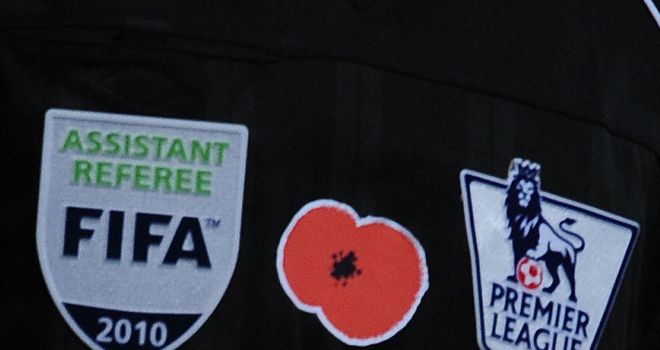
So after much consternation and brouhaha, the English and Welsh FAs have been granted a compromise by FIFA which will see them wear an armband with a poppy rather than a poppy on the front of the shirt.


Bravo, victory for the British associations. To think that FIFA were actually trying to tell the English FA what to do! Do they not know that England invented the game? The cheek!

FIFA eventually relented from their previous position when the political figures Prince William, Duke of Cambridge and British Prime Minister David Cameron wrote to FIFA, presumably telling FIFA how it was wrong to prohibit the poppy and that there was absolutely nothing political about it.

Nothing political... right.

The Royal British Legion said the dispute was not between itself and FIFA, nor even the English FA and FIFA, but the British public and FIFA. How's that, eh? Indeed, the British media has already described FIFA as having "backed down" and yielding to the "demands" of the English FA. But in reality, it's more like a tired parent granting a petulant child one sweet rather than the whole bag.

The world governing body of football expressly forbids the flaunting of political, religious or commercial messages on the shirts of their member associations. That seems fair enough to me. International sport is political enough without encouraging aggressively partisan advertisements.

Ah, but being told what to do doesn't sit right with some. The whole affair reminded me of the time when another British association, namely the Irish FA, took FIFA - and the Football Association of Ireland - to the Court of Arbitration for Sport with the complaint that FIFA were interpreting their own eligibility rules wrongly, to the detriment of the IFA. Yes, really. Read that back to yourself again.

I'm slightly disappointed with FIFA's decision. They granted a compromise after an unremitting media storm, coupled with British politicians flexing their political muscle.

But if the English FA and the British public feel like honouring members of a force whose purpose often involves murder, by creating a shameful fuss about wearing a poppy on their shirts at a football game, essentially diminishing the whole thing to a fashion statement, they can knock themselves out.

Wednesday, 9 November 2011

A Load of Poppycock!

The Poppy on England jacket
After a wave of media reportage on the issue, British Prime Minister David Cameron has also issued a scathing attack on FIFA after the world football governing body remained steadfast in its decision to prohibit the English national team from wearing poppies on their shirts for the upcoming game against Spain.


Cameron said:
"This seems outrageous. The idea that wearing a poppy to remember those who have given their lives for our freedom is a political act is absurd. Wearing a poppy is an act of huge respect and national pride. I hope that FIFA will reconsider."
Wow. What rhetorical nonsense. Cameron fails to see the irony of a politician playing down the political symbolism of the poppy. Downplaying politics in international sport is in itself futile, since international sport is inherently political, nations representing states and whatnot.


Wearing the poppy might be an act of respect to some, but it also glorifies war in an overtly triumphalist manner. Creating such a bluster over the manner is unneccessary and counterproductive. A cynic might say it demonstrates the obstinacy of the English FA.


Calm down lads, it's only a poppy. You can pay your respects in other, less ostentatious ways.


You might even have a bit of class.

Once in Six, our luck has to change

Below is an article which appeared on SportsNews Ireland on 9/11/11.

Since 1965, the Republic of Ireland have competed in 6 play-offs for qualification to the final stages of major tournaments and only once, have they been successful; a remarkable statistic indeed.

It is often said that Ireland never make things easy and it is true that following the fortunes of the Irish national team can be an emotionally tasking endeavour: wherever Ireland go, drama is not far behind. This is especially true of play-off games.

Eamon Dunphy
World Cup 1966 – Spain 1-0 Ireland (Stade Colombes*, Paris, 1965)
Interesting circumstances led to Ireland playing Spain three times in the qualifying stage for the 1966 World Cup. The withdrawal of Syria from the competition meant that there remained only two teams in the group. While Ireland triumphed 1-0 over Spain at Dalymount Park, Spain responded by trouncing Ireland 4-1 in Seville leading to a “best two out of three” play-off to decide the group winner. The game was played at a “neutral” ground, in France, although London had also been considered as a venue. However, Stade Colombes turned out to be less neutral than anticipated, as the Spanish diaspora in France swarmed the ground, roaring the La Roja on to a 1-0 victory, thwarting Irish hopes of qualification.


Patrick Kluivert
Euro 1996 – Ireland 0-2 Holland (Anfield, Liverpool 1995)
Just over thirty years after the defeat to Spain in France, Ireland found themselves on the cusp of qualification for Euro ’96, with the mighty Dutch Oranje standing in their way. During the period between 1986 and 1995, Ireland had experienced their most successful period under the stewardship of Jack Charlton. Prior to this fixture, the affable Englishman had guided the Boys in Green to three major tournaments, missing out only on Euro ’92. However, with several key players unavailable, including midfield general Roy Keane and target man Niall Quinn, an ageing Ireland team struggled to impose their will on the Dutch and Patrick Kluivert, who had earlier that year scored the goal that clinched the first European Cup for Ajax since the days of Cruyff, scored two goals to condemn Ireland’s qualification hopes. After just under a decade, it proved to be Jack Charlton’s final game as Ireland manager.


Denis Irwin
World Cup 1998 – Ireland 1-1 Belgium (Lansdowne Road, Dublin, 1997); Belgium 2-1 Ireland (Stade Roi Baudouin, Brussels 1997)
The end of the Charlton-era saw the appointment of Mick McCarthy as Ireland manager. McCarthy had been a bustling centre half, captaining Ireland in major games, and following in the footsteps of Jack Charlton, the expectations of him were high. Nevertheless, while McCarthy’s men struggled through qualification for the 1998 World Cup, they secured a play-off fixture against Belgium. The first leg finished 1-1, with Denis Irwin scoring. The result meant Ireland needed to score in Brussels to cancel out the Belgian away goal. However, it was the Belgians who took the lead mid-way through the first half. Ray Houghton scored a skilful header to equalise, but luck was not with the Irish in Brussels, as the Belgians scored a goal resulting from a dubiously awarded throw in in the Irish half. It finished 3-2 on aggregate and once again, Ireland failed to qualify.

Euro 2000 – Ireland 1-1 Turkey (Lansdowne Road, Dublin 1999); Turkey 0-0 Ireland (Atatürk Olympic Stadium, Bursa 1999)
After failing to qualify for France ’98, Mick McCarthy was hopeful of securing qualification to Euro 2000, which was hosted by former foes Belgium and Netherlands. Indeed, Ireland could have won automatic qualification in this campaign had they defeated Macedonia in Skopje, but, once again, it was not one for the faint of heart, as Goran Stavreski scored an equaliser in the final minute of the game to make it finish 1-1. Ireland were instead drawn against Turkey in the play off and despite the heartbreak of missing out in the last minute, McCarthy’s men remained optimistic. Robbie Keane scored in the 79th minute to give Ireland the lead, but his goal was cancelled out 5 minutes later, as Lee Carsley gave away a penalty, which was coolly converted by Tayfur Havutçu. Havutçu’s penalty proved to be the decisive blow for Ireland, as the away tie ended 0-0 and Ireland were dumped out of the competition by an away goal. It was a highly charged affair and the emotions spilled over at the end of the game, when Tony Cascarino found himself embroiled in post-match conflict involving a few Turkish players and riot police. Then FAI president Pat Quigley branded the scenes “unacceptable”, but it was the failure to qualify that Irish fans found to be unacceptable.

Azadi Stadium
World Cup 2002 – Ireland 2-0 Iran (Lansdowne Road, Dublin 2001); Iran 1-0 Ireland (Azadi Stadium, Tehran)
Things continued to improve after the disappointment of 1999 and in spite of being drawn in arguably one of the most daunting qualifying groups, Ireland managed a truly commendable feat by finishing the group unbeaten and level on points at the top of the table with Portugal. Jason McAteer scored the winning goal against Holland at Lansdowne Road in a moment which will live forever in the minds of the Irish support. Only goal difference separated Ireland and Portugal and Ireland were drawn against Iran in the play off. Brimming with confidence and keen to succeed, Ireland eventually overcame the nerves and cruised to a 2-0 victory in the home tie, before braving the utterly intimidating atmosphere of the Azadi Stadium in Tehran. Faced with the vitriol of 100,000 odd supporters, Ireland held on to win 2-1 on aggregate and Mick McCarthy became the first Irish manager to win a play off.

"Thief of St. Denis"
World Cup 2010 – Ireland 0-1 France (Croke Park, Dublin 2009); France 1-1 Ireland (Stade de France, Saint-Denis 2009)
Undoubtedly the most dramatic of Ireland’s play offs, the World Cup 2010 play off was marred by the controversial hand-ball incident involving Thierry Henry, the “Thief of St. Denis”, as George Hamilton would say. The fixture was actually marked by controversy from the beginning, as the powers-that-be decided to seed the draw, eliciting criticism from the smaller associations who had made the playoff. Amazingly, Trapattoni’s men had passed through the group stage unbeaten, but a deflected Nicolas Anelka shot dipped over Shay Given to grant the French victory at Croke Park. Despite efforts by the fans to “Turn Croke Park Green” and to create an electrifying atmosphere in the ground, the Irish team found it difficult against the French and many fans became pessimistic about the away tie. Yet, it happened to be a fantastic performance, lauded by pundits and commentators as the best Irish performance in years. Captain Robbie Keane and veteran winger Damien Duff admirably led the charges and took the game to France. Keane scored a wonderfully worked goal and Ireland created a mountain of chances, but failed to make them count as William Gallas, aided by the hand of Henry, knocked the ball into the Irish net in extra time. It finished 2-1 on aggregate and Trapattoni and his men were sent back to the drawing board to contemplate another campaign.

*There is conflicting information regarding the stadium, with some stating that Parc des Princes was the venue.

Saturday, 5 November 2011

Second Class Irish?

Token citizenship?
During the past few months, I have developed a deep resentment of the nature in which I, as an Irish citizen, am treated by the establishment in the south. I have spoken to people in the public service, friends and colleagues, outlining how I feel discriminated against - that my Irish citizenship amounts to nothing more than a token gesture and that my Irishness appears to be secondary to the Irishness of someone who happened to have grown up south of the border.

Obviously this attitude has existed for years and years - I am not the first, nor will I be that last to endure such discrimination - but, it is important to note that, precedence does not legitimize it. It is an abhorrent attitude which must be vehemently challenged by all Irish citizens, particularly those from the north, if we are to take any value from our citizenship. And after all, what is a state without its citizens?

Recently, such partitionist attitudes were showcased in the media of the southern state, with many commentators stating that, while Martin McGuinness was good enough for the northern executive, he wasn't acceptable in office in the south. In Pat Kenny's Frontline presidential debate, an audience member rejoiced in her ignorance of the Troubles, "I don't want to know about it.", she happily declared to the nation.

Not only is this lady's attitude an affront to her fellow Irish citizens on both sides of the border, her outright and wilful ignorance is an insult to the intelligence of any half-way educated person. I'm not sure how widely her views are held, but it is nevertheless worrying.

Irish citizens in the north must begin to take a much more active interest in the affairs of the Dublin government in order to encourage, nay demand, that their rights as citizens of the Irish state are upheld, that they are cherished and cared for in the same way any other Irish citizen would be, instead of being viewed as peripheral and second-class Irish.

Sunday, 30 October 2011

Blarney Castle and Re-imagining Irishness

I had the great pleasure of visiting Blarney Castle yesterday. What a magnificent place, it's almost magical. However, after facing the terrific climb to the top of the castle, I did not bring myself to kiss the stone, for in the words of George Bernard Shaw,
"....it is not necessary for me to seek eloquence at Blarney....my natural gifts in that direction being sufficient, if not somewhat excessive."
Not really - in fact, my natural gifts in that direction are somewhat questionable - the actual reason for refraining from kissing the stone was due to the horrific rumours I'd heard about the treatment of the stone by devious miscreants. How true those rumours are, I'll never know, but I didn't want to find out, much less smear them all over my mouth.

The day before, Ireland became aware of its new President. Labour man-of-letters, Michael D. Higgins is now the 9th President of Ireland. Fair play to him, it was pretty much a certainty from the beginning. Well, that is until failed businessman Sean Gallagher inexplicably emerged as the front-runner for a while. Mr Gallagher could well have been crowned, I mean, inaugurated as our new President, if it were not for Martin McGuinness' revelation that Gallagher had been involved in some shifty financial dealings as part of Fianna Fáil, thus reminding the electorate of all that Gallagher stood for.

And so it was, Michael D. Higgins swept home to victory, leaving Gallagher in his wake, with your man from 'up-there' coming in third - can you imagine what might have happened had a northerner been elected again? Perish the thought. They're not allowed the vote, why should they be allowed to be Uachtarán?

Indeed.

So now we should see the development of the "New Ireland" that Michael D. Higgins of the Labour Party envisions. He wants to examine and re-examine Irishness, to redefine it. He will invest in our national character, our predilection for the arts. One wonders will he continue to trot out the line of Enda Kenny that "Ireland is open for business" (was it ever "closed"?) as though he were the pimp of the nation?

From my own point of view, I truly hope that Higgins does not forget the Irish people of the counties of Derry, Antrim, Down, Armagh, Tyrone and Fermanagh and I hope he finds room for them in his re-imagination of Irishness. Partitionists from both sides of the border may chime and chide that he's just for the 26 counties, (that's the Republic, ya hear!), but they are deluded. A state is nothing without its citizens.

Thursday, 13 October 2011

A Match Made in Heaven

Estonia defeat Northern Ireland
A chorus of joy rang out around Ireland as Zbigniew Boniek announced that Estonia would be Ireland's opponents in the Euro 2012 Play Offs. Out of the four possible opponents, Estonia was viewed by many as the dream draw and it's hard to disagree with the reasoning. However, many journalists and sports writers are already suggesting that it is likely that we were probably Estonia's dream draw. So what we've got now is a match made in heaven.

Maybe Trapattoni's alleged Opus Dei connections have been at play; maybe he was right about Saint Patrick being a fan of the FAI. Darren O'Dea, too, seemed to know something that we all didn't when he said he was sure that we'd be in Poland and Ukraine next year. However, there is one more trial to be completed before the prophecy of the centre-half can be realised.

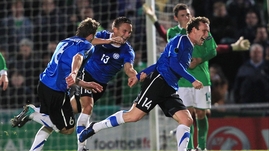
Estonia emerged from a tough qualifying group in which they were fifth seeds, catapulting themselves up the ladder of the FIFA rankings along the way, with convincing away victories over Serbia and Slovenia, as well as beating Northern Ireland at home and away. They have, nevertheless, shown themselves to have the inconsistency that is typical of weaker teams, having been beaten by Brian Kerr's Faroe Islands. That said, for a nation of Estonia's stature in football, similarly to Armenia, to get this far is a marvellous achievement and their players will no doubt be spurred on by their status as underdogs.


Therefore, Trapattoni must once more remind his players of the perils of complacency and ensure that the results send us on our way to Poland and Ukraine. Come on you Boys in Green!

Wednesday, 12 October 2011

It's Not Over Yet

Berezovski receives a red card (Uefa)

I came away from last night's victory with a few thoughts amid the joy of having inched that bit closer to the European Championships. As is often the case, Ireland seemed to have that bit of luck and as usual, there was an edginess to the performance that would give even the most patient of saints a reason to crack. Trapattoni's regime has been such that for every positive result there is a negative that needs to be addressed.

Simon Cox conceded that Armenia's goalkeeper, Berezovski, was unlucky to have been sent off. Indeed it could have gone either way. According to the commentary on RTÉ, it was Mr Gonzalez's last game as a referee, so I sense that he unwittingly attempted to steal the show by showing eight yellow cards and sending two men off. Nevertheless, these things happen in football, like the infamous “Hand of Gaul” incident in that play-off in Paris. Until such times when the powers-that-be introduce video replays, you play to the whistle and get on with it.

Ireland's tactics were straightforward but undeniably effective. The Armenians were unable to deal with Shay Given's long balls and they struggled to stifle the wily movement of Cox and Doyle. However, despite the pressure, Ireland were unable to capitalise until the 43rd minute and even then, needed a favour in the form of an Armenian own goal. The Armenians, playing with 10 men having had a man controversially sent off, were right to feel aggrieved, because despite the disadvantage, they still managed to control a sizeable portion of the possession - a marvellous testimony to the technical ability of this young Armenian side. At 60 minutes, Richard Dunne pounced on the inexperienced substitute goalkeeper's reticence (he was 17!) to make it 2-0 and Ireland were in cruise control, at least Trapattoni's type of cruise control. At one stage Armenia had 71% of the possession, which would be a frightening statistic to anyone else, but Trapattoni is happy for the opponent to keep the ball as long as his team is winning.

Despite being comfortably in the lead, several Irish players displayed the reckless complacency that has cost Ireland in the past. Aiden McGeady, for example, had an atrocious evening; the tricky Glaswegian simply could not beat his man and insisted on wasting possession almost every time he got the ball, which is completely unacceptable at this level, when so much is at stake. The Armenians even snatched a goal, in what was almost a carbon copy of the build-up play that saw Ireland concede a wonder-goal against Andorra - a weak clearance from a high ball and an abundance of space afforded to the Armenians due to poor positioning from the Irish midfield, Keith Andrews in particular, who was nearly 20 yards away from where he should have been. Certainly, Shay Given could have been better for the shot, but I'd argue that Mkhitaryan should not have been allowed the time and space to shoot and for this reason, Andrews is most culpable. Not only does Andrews lack the positional awareness and tackling ability for his role, he lacks the imagination, as was frustratingly showcased as he squandered an amazing counter-attack opportunity when he played the ball backwards, towards trouble. Kevin Doyle will miss the play-offs as a result of controversial refereeing, but he didn't help his case with the indiscipline he had previously displayed when he needlessly picked up a yellow card.

Thankfully, Ireland are seeded for the play-off draw, which will see them face Bosnia & Herzegovina, Estonia, Turkey or Montenegro, but Trapattoni should remind his players to be wary of complacency. By world football standards, of this group, only Turkey has made an impact, but each of these teams is here by virtue of their quality and like Armenia, must not be underestimated. Ireland have faced Montenegro in the past and it is important to note that Estonia have moved from 86th to 58th in the FIFA rankings while Bosnia & Herzegovina have moved to 22nd . So regardless of who is drawn out of the hat on Thursday, Ireland can be sure of a tough task. The roller-coaster ride is far from over.

Tuesday, 11 October 2011

Ongoing Eligibility Row? Where?

To describe the eligibility of Northern Ireland born Irish nationals in the context of association football as an ongoing issue is, quite simply, a falsehood, because it is not an ongoing issue. Indeed, as the Football Association of Ireland (FAI) said in a statement issued in response to the recent upsurge of speculation in the media, the decision reached by the Court of Arbitration for Sport (CAS) in the summer of 2010 granted the issue finality, once and for all. I have written extensively about the eligibility issue in the past, for the simple reason that it is something which presents a principle which is important to me, and over the past few months, it is the ignorant outbursts of Gerry Armstrong, the Irish FA's (IFA) newly appointed 'Elite Player Mentor', that have been the subject of my scorn.

Despite the emphatic nature of the finality which followed the outcome of that court case in Lausanne, elements within the media have deviously sought to ensure that the issue remains at the front of the minds of football fans in Ireland. The idea behind mounting such an aggressive media campaign, presumably, is to effect some kind of change by maintaining an atmosphere of discontent among Northern Ireland fans and, at the same time, attempting to encourage a feeling of sympathy or unease among Republic of Ireland fans. The rabidly sensationalist stories which continue to prevail are typically written by resident hacks who are embarrassingly ignorant of the statutes governing eligibility, as well as the very recent court case on the issue and they insist on propounding myths and outright lies in an effort to stir up frenzy among the Northern Ireland fan base. Of course, that many of these writers are sympathetic to, or even fans of, Northern Ireland is acceptable, but what is utterly inexcusable is the stubbornness of their ignorance in the face of readily available facts. It seems to suggest a defiant 'head-in-the-sand' mentality.

Since his appointment by the IFA as the association's 'Elite Player Mentor', Gerry Armstrong has continued this frustrating habit. The former Northern Ireland international has been extremely vocal about his intentions to persuade players to stick with, declare for, or in some cases return to, the IFA. However, it is hard to take anything Armstrong says seriously when he comes out with such short-sighted, erroneous gems as:

"If you are born in part of Northern Ireland that is your country of birth and usually, under FIFA or UEFA rules, that would be the country you would play for.

As well as the oft-repeated fallacy that,
"Because of the Good Friday Agreement if you are born in Northern Ireland you can play for Northern Ireland or you can play for the Republic of Ireland"

In light of such astounding ignorance, it seems only logical to conclude that Armstrong, who is a relatively senior public figure within the IFA, does not have the faintest clue about that which he is talking about, which is odd, because the CAS case was, in effect, an expensive lesson in interpretation for the IFA. Amazingly, Armstrong has also been making completely unsubstantiated allegations against the FAI in the local media, claiming that the association is actively engaged in the “tapping up” of players aged 15 and 16 years of age – a claim which has been resolutely refuted by the FAI, who have stated their view that it is a player's prerogative whether or not they wish to play for their teams.Furthermore, Armstrong suggests that young players are facing pressure “from a political point of view”, whatever that is supposed to mean. The credibility, if there ever was any, to Armstrong's allegations is undermined substantially by the fact that, rather hypocritically, he is currently engaged in the “tapping up” of players who are registered with other associations, including players who were not actually born in Northern Ireland, such as Anton Rodgers, an English-born footballer who plays for the representative teams of the FAI.

If anything worthwhile can be taken from the recent proliferation of articles in the media, it is that, in the realm of complex issues such as national team eligibility, Irish football fans should always be wary of the oblique musings of former footballers. Instead, they should ideally refer to the report which was issued by the CAS following the IFA's complaint against FIFA and the FAI. Failing that, they should consult Daniel Collins' article 'FIFA Player Eligibility in the Context of Ireland: The Actual Rules, the Real Facts and Dispelling the Prevailing Myths' (2011), which remains one of the most in-depth examinations of the issue and outlines, with brutally clinical concision, how Gerry Armstrong and others of his ilk are absolutely out of their depth on this issue.

This article appeared on Backpage Football on 20/10/11

All the King's Men


Ireland U21 Team v Hungary
Ireland under-21 boss Noel King has now been in the job for over a year and having inherited a talented group of players, he has improved significantly on Don Givens' efforts as coach with some reasonable results. Ahead of Ireland's under-21 game against Liechtenstein, it is worth looking at the wealth of talent which bubbles beneath the senior squad, in what is quite a young under 21 group.

Goalkeepers
Ireland has never been spoiled for choice when it comes to goalkeepers, but has been lucky enough to have two colossal Donegal men between the posts for the majority of the past 20 years. However, there is a growing worry that once Shay Given hangs up his gloves, with no obvious young pretender ready to pick them up, Ireland will face a goalkeeper crisis. King has experimented with several goalkeepers but only one has been ever-present in his squads and that is Dubliner Ian McLoughlin. The towering custodian has firmly established himself as King's number one. Now 20 years old, McLoughlin began his professional career at Ipswich Town but has since moved on to League One outfit MK Dons after brief loan spells at Lowestoft Town and Stockport County.
King has also used the likes Richie Branagan and Michael Quirke in friendly games, but it is Monaghan man Aaron McCarey who has emerged as understudy to McLoughlin. The 19 year old Wolves reserve goalkeeper Aaron McCarey had long been number one at under-19 level and after Ireland's impressive run in the Under 19 European Championships, UEFA picked McCarey out as “One to Watch”, describing him as an “intimidating figure inside his area”. He has recently made the step-up from Paul Doolin's under-19s to Noel King's under-21s but is currently the second choice, although he will undoubtedly stake a strong claim for the number one shirt.

Defenders
Through the years, Ireland has had some tremendous defenders playing football at the highest level. Kevin Moran, Paul McGrath, Steve Staunton and Denis Irwin are just some of the names that immediately spring to mind. However, in recent times, there has been a lamentable drought of talent and Richard Dunne is arguably the only defender worth talking about in the same bracket as the aforementioned individuals. Amazingly, Noel King has been deploying a defence made up of four natural centre backs and each of them possess undoubted potential to progress in the game. 20 year old Rob Kiernan is an English born Irish under age international who recently signed for Wigan Athletic and is currently King's captain, having captained previous Irish teams. The centre-half started his career as a midfielder but switched to defence and he has been ever-present in Noel King's backline since he took over.
Niall Canavan is another English-born Irish international who currently plies his trade at Scunthorpe United. The 20 year old declared for Ireland in 2011, and has emerged as Noel King's preferred choice alongside Rob Kiernan at centre-half. Canavan has played many games for League One team Scunthorpe, and while 'Iron' fans have high-hopes for the young man, he has found his appearances limited with fellow Irish international, the on-loan Shane Duffy, being Alan Knill's preferred choice. 19 year old Derry man Shane Duffy already has a wealth of experience behind him. The giant centre-half made his Everton debut at the tender age of 17 and could possibly have had senior international honours had he not suffered a life-threatening injury at 18 while with Trapattoni's senior side. Duffy had a loan spell at Championship outfit Burnley in the 2010-2011 season and is currently on loan at Scunthorpe United where he has firmly established himself in Alan Knill's starting eleven.
Bolton's Mark Connolly is another centre-half in King's squad, but he has been playing mostly at right back or in midfield, a versatility that the Monaghan native believes is an invaluable strength in the modern game. Now 19 years of age, Connolly's manager Owen Coyle has stated his willingness to play the defender at centre back. Gavin Gunning is a further natural centre-half but is equally adept at left-back, which is where he has featured during King's tenure. At 20 years of age, Gunning is arguably one of the most experienced and certainly one of the most decorated players in the squad, having represented Ireland at all underage levels. He kicked off his career at Blackburn, but has since moved on to SPL side Dundee United after several successful loan spells in Scotland and the lower leagues in England. Left back Greg Cunningham is only 20 years of age yet has already featured three times for Giovanni Trapattoni's senior side. The Galway man suffered a horrendous leg-break in the 2010-2011 season, but has since returned to full fitness and has been included in Noel King's squad to face Liechtenstein.

Ireland U21s versus AustriaMidfielders
Despite the vast improvement on Steve Staunton's regime, the reign of Giovanni Trapattoni has also embarrassingly exposed the painful weakness in the Irish midfield. For all their efforts, the likes of Glenn Whelan, Keith Andrews, Darron Gibson and Keith Fahey have been largely ineffective in the rigid 4-4-2 formation, with many fans begging for a change of formation, or at least mentality. Noel King's under-21 side, in contrast, is brimming with talent in the middle of the park. Chelsea reserve player Conor Clifford has represented Ireland at all underage levels, often playing a full year above his age-group. A skillful midfielder with great vision and a powerful shot, the 19 year old captained Chelsea to FA Youth Cup glory and has had two loan spells to date, with Plymouth Argyle and Notts County. Indeed, Clifford's progress was recently recognised with a call-up to Giovanni Trapattoni's senior side in August 2011.
Dubliner Robbie Brady is a real star in the making. The 19 year old Manchester United winger is currently on loan at Hull City where his dazzling skill and speed has already made him a fan-favourite. Interestingly, the former St Kevin's Boys player's Ireland career appeared to be in doubt following an alleged disagreement with under 19 manager Paul Doolin prior to the Under 19 European Championships, but he has since made the step up to under 21 level and, to Noel King's delight, has been thriving, scoring three goals in five appearances. After experiencing recurring injuries early in his career, Brady is finally realising his massive potential.
Leeds United player Aidy White recently declared his allegiance to Ireland in 2011 after having played for England at under 19 level. Equally adept at left-back or left-wing, White has been playing on the wing for Noel King and has impressed greatly in his three performances to date. 20 year old Celtic player Richie Towell is currently into his second loan spell at Hibernian. Another versatile player, Towell can play at right back, but it is at centre midfield where he has impressed for Noel King's under 21s. Towell is a tireless ball-winning midfielder who commits himself admirably to tackles. A controversial recent inclusion in King's under-21 side is Preston North End player Adam Barton. Barton is a lanky, but graceful attacking midfielder and it is interesting to note that the English-born 20 year old actually has a senior cap for Northern Ireland. However, he opted to play for the Republic instead and has since represented the FAI on two occasions. Derby County midfielder, Jeff Hendrick has made the step up from under 19 level to cement a starting berth in King's under 21s. The 19 year old has a tremendous amount of potential, which has been showcased in his performances for Derby this season.
Strikers
With Robbie Keane entering the twilight of his career, Ireland are in desperate need of a goalscorer. Sadly however, there is a distinct lack of firepower in Noel King's under 21 squad. Nevertheless, King has utilised a number of quality players in attack. For example, the likes of Crystal Palace forward, the English born Sean Scannell has shown that he has plenty of potential. Indeed, Scannell was previously included in Giovanni Trapattoni's senior squad; unfortunately, the 21 year old has been plagued by injuries, forcing him to withdraw from many squads. Arsenal youngster, the English born Rhys Murphy, has also recently declared for Ireland having played at under 19 and under 17 level for England, while English born James Collins has been a regular for Ireland at under 19 and under 21 level. Collins started his career at Aston Villa but now finds himself with League Two side, Shrewsbury. Finally, another English born player, Joe Mason, who has played for Ireland at under 19 and under 21 level is now playing regularly for Cardiff, having signed from League Two outfit, Plymouth Argyle.

Wednesday, 5 October 2011

On the Campaign Trail: Gay and Martin

Gay Mitchell, Irish Rover

In between my attempts to be taken seriously as an academic, I've been trying to stay tuned into the developments of the Presidential election and the thing that has recently come to the fore, is the self-proclaimed “Street-Fighter” attitude of Fine Gael candidate Gay Mitchell.

Mitchell, we are told, has now been let loose – like a rabid political dog – on Martin McGuinness. “I'm not afraid of you, Martin!”, he declared triumphantly on Eamon Dunphy's radio show on Newstalk. And many commentators suggest that Mitchell's zealous attacks on McGuinness will ultimately prove to be a fruitful endeavour, if only for the sake of “honour”. Eoghan Harris for example, in a piece for the Irish Independent, would have us believe that Mitchell was ready to step into a ring with McGuinness, that he was a man of robust character who has been preparing for and relishing this opportunity for years. Just postpone the thoughts of Mr Burns and the release of hounds for a second, for in the same article, Harris amazingly states that “IRA tribalism is to Ireland what anti-Semitism was to Germany”. His endorsement of Mitchell, therefore, appears to be one of desperation.

The fighting Irishman Gay has constantly reminded us of how, growing up in Dublin, he and his family endured a difficult time, riddled with sudden bereavement and financial hardship. Strangely, however, he attempts to frame this in the exact same context of Martin McGuinness growing up on the streets of Derry. Such a ludicrous comparison does not make Mitchell out to be heroic, but rather ignorant. I'll go out on a limb and guess that Mitchell didn't live in an institutionally gerrymandered city, where the state felt he was a second-class citizen, considered him a threat to the status quo and even shot at him, killing and injuring his fellow citizens. But no, he insists that “I've had a hard life Martin, yet I didn't resort to the gun.”, noble as he is. I think Father Sean McManus summed it up perfectly when he, quite reasonably, said:

"How have McGuinness’s critics resisted British injustice and anti-Catholic discrimination and inequality in Northern Ireland?"

Mitchell's other gripes concern the financial well-being of McGuinness and the fact that he is inextricably linked with Sinn Féin. That McGuinness is inextricably linked with Sinn Féin is no secret, so to continually raise it as an issue seems pointless and with regard to Mitchell's scepticism over salaries, McGuinness responded by releasing his financial details to the public, thus taking the wind out of Gay's sails. Mitchell is certainly not stupid, but one must wonder at the rationale behind his militant stance on McGuinness and whether it will serve to gain him votes.

It's all very interesting to observe as the events unfold, it is absolutely entertaining. McGuinness has his enemies; be they those angered by his involvement in the Troubles, dissident republicans who feel he has sold out “The Cause”, or southern politicians who simply loathe the rise of Sinn Féin. At the same time however, he most certainly has his sympathisers and Mitchell's frequent, somewhat obsessive tirades may just grant him a few more. Sinn Féin and McGuinness have a past that is rooted in violent conflict, but they also have a vision for the future of Ireland and as someone who hopes to see the reunification - the freedom - of Ireland, I can't see any other party working for it in the way that Sinn Féin is. Their approach is now one of pragmatism, although many will argue that it is completely hypocritical, and while the President's role is largely ceremonial, I want to see a President who takes the entire people of Ireland seriously – not one who thinks Ireland ends at Dundalk and Letterkenny.

Sunday, 2 October 2011

What about those puppet shows, Gregory?

Gregory Campbell (Belfast Telegraph)
So Gregory Campbell of the DUP has branded a Presbyterian minister a puppet for endorsing Sinn Féin's Martin McGuinness. The gall of that Reverend, eh?  I mean, how dare a Protestant support a republican? He should know better - sure isn't republicanism and nationalism just for Catholics, like? Our grafitti will show him.

Such rash and frankly childish name calling is, of course, completely unnecessary and it makes one truly wonder as to the internal machinations of some people - it's not new, but the point is that it never ceases to amaze. However, if anything, once more, it serves to expose the outright naivety of auld Gregory and others within unionism/loyalism.

Republicanism is not a sole refuge of Catholics, nor is unionism a sole refuge of Protestants and anyone with the slightest interest in Irish society through the years will know that. Perhaps auld Gregory is worried that it might become fashionable or something, that people might not feel bound to an ideology because of their spiritual outlook. Imagine that now, religion not necessarily dictating one's politics.

That'd be the day.

Friday, 30 September 2011

Do Yourself a Favour

If you really want to do yourself a favour, and you don't quite know what to do, you can start by listening to a TED talk.

It doesn't matter what the subject matter is or who you are, you are bound to come away from the experience feeling different and I say this, not as a person who uses this resource religiously, but as a shameless knowledge mercenary who dips in sporadically when the fancy takes him.

The premise of TED is simple but marvellously effective: brief, captivating and stimulating talks about "ideas worth spreading", given by "remarkable people". Bravo. It's like college without the tedium - very rarely will you find a protracted hour or two-hour long lecture about a topic you deem to be boring.

TED talks will enlighten and inspire you. You will be better off having indulged and who knows, something may ignite a passion spark inside of you and "God knows" (to steal a phrase), we all want to be passionate about something. So, do yourself a favour.

_________________________________
I recently watched one by Dan Gilbert which can be found by clicking HERE.
More videos are available at www.ted.com

Thursday, 29 September 2011

Armenia, the Dark Horses

From UEFA: Keith Fahey's anomaly

With just over a week left before the Republic of Ireland's final games of the European Championships Qualification campaign, one hopes that Trapattoni and his men begin to grasp the importance of taking control of their destiny. At this stage, Ireland have relinquished control of their destiny – one dire performance after another means that automatic qualification ultimately rests on whether Russia drop points in their final games. Nevertheless, the Boys in Green must still win their final two games if they are to retain even a sliver of hope, at least.

Andorra are, rightly, considered to be the minnows of the group. They have lost all eight of their games so far, conceding 17 goals along the way. However, they are not exactly the “whipping boys” they once were and have forged a system of defence which has seen them generally come away from games with a respectable scoreline. They even have the ability to score the odd goal, but it most certainly is odd. In this group, they have scored just one and that was, interestingly, against Ireland. In their last four games, they have conceded 6 goals and it is interesting to note that 50% of those came from Armenia.

Armenia have emerged from obscurity as the dark horses of group B and they present a serious threat to Ireland's chances of qualification. With a remarkable 17 goals scored, they have netted the most goals of group B to date, while they have only conceded seven – just one more than Trapattoni's men. In their last four games, they have scored eight goals, conceding three away to Russia. Ireland, in contrast, have scored just four, conceding only one and each of those goals came against Macedonia. The dichotomy is clear to see, and it is startling. The difference between Ireland and Armenia, is that Armenia can score goals when they need to, a fact which was emphatically showcased as they hammered Slovakia both home and away. Ireland in the same fixtures, slumped to two uninspiring stalemates. In their games against Russia, Armenia managed to draw at home and even took the lead away, before being defeated by three goals to one. Ireland on the other hand were simply diabolical in their displays against Russia – trounced 3-2 in Dublin and managing a miracle 0-0 draw in Moscow.

Trapattoni's men must be spirited and they must perform to the best of their ability, otherwise Trapattoni's system will be embarrassingly exposed once more. Indeed, Armenia's recent form makes Ireland's 1-0 away win in Yerevan last September seem like an anomaly and it might well prove to be.

*This article is due to appear on Back Page Football on 05/10/11

Friday, 23 September 2011

Wise Up, Gerry

Gerry Armstrong
The IFA's Elite Player Mentor, Gerry Armstrong, has issued a robust warning to those who are considering changing from the IFA to the FAI. He is urging them “to look before [they] leap”.

In his recent newspaper column for the Sunday Life, Armstrong has penned his most embarrassing article to date, an article which is characterised by an astonishing level of paranoia and outright ignorance. Indeed, such is the utterly delusional nature of his rambling that one might be forgiven for mistaking it for the blind-rage-fuelled rhetoric of the conspiracy theorists who accuse the FAI of sectarianism and plotting the downfall of the IFA. In fact, I suspect the column may, in fact, be the work of a conniving ghost-writer, but enough of my conspiracy theories.

“I've thought for some time and I still hold the view that the predator that is the FAI is simply taking players for the sake of it and at the same time knowing they are depriving Northern Ireland.”
- Gerry Armstrong.

In describing the FAI as a “predator”, Armstrong's credibility begins to crack, before it crumbles entirely with his erroneous statement that the FAI “may be within their rights because of the Good Friday Agreement”, concluding with his perfect moral compass that “what they are doing is morally wrong”. Two things: not only does the Good Friday Agreement have nothing to do with the scenario and since when did Gerry Armstrong and the IFA have a monopoly on moral judgement (and that's completely disregarding the fact that they too, are in the business of “poaching”)? Someone should remind him that they do not exist in a bubble.

Not content with flaunting his ignorance in those statements, the former international then goes on to expose what is quite an insulting and narrow-minded viewpoint - that national team eligibility should be determined by where one was born, not nationality - and that, my friends, just about sums the mindset up.

For, you see, the simple fact is that the IFA is as self-interested as any other football association. It does not possess the moral high-ground that it so foolishly tries to claim. Its agents have indulged and continue to indulge in the same type of “poaching” it claims to be a victim of and, crucially, it does not own players who are eligible for its teams.

Just read the CAS ruling, Gerry, or at least have a look at Daniel Collins' piece on the matter. Good man.